Stories of the Rogues
Check back often to read new posts or better yet, subscribe below to get them delivered.
-
Do not marry downward
Read more: Do not marry downwardThe book Home and Health (and) Home Economics, published in 1880, offers readers advice on everything from disease prevention to funeral etiquette. Authors CH Fowler, DD, LLD and WH De Puy, AM, DD also offer their thoughts on marriage. It is this advice, reflecting a prevailing attitude at the time, that stopped many struggling young women from marrying- and taking the (unfortunately) best route they had to economic stability and a better life.
Marry in your own grade in society, they advise, adding that it is painful to always be apologizing for any one. And, they added, it is more painful to be apologized for. They also offer this tidbit:
Do not marry downward. It is hard enough to advance in the quality of lie without being loaded by clay heavier than your own. It will be sufficiently difficult to keep your children up to your best level without having to correct a bias in their blood.
Unfortunately many young girls grew up in struggling families and philosophies like this drastically limited their options, consigning many to long hours, and years, at canneries, laundries and sweatshops earning starvation wages. It is no wonder some turned to prostitution, which was dangerous but offered more money and at least the possibility of gaining some financial independence.
-
Eureka full of suckers- but who wouldn’t trust a Reverend (or the Delmars) ?
Read more: Eureka full of suckers- but who wouldn’t trust a Reverend (or the Delmars) ?
Times Standard, June 1903 Fortune telling has always been big business – and though I can’t pretend to know if some folks have the ability to sense what is beyond the physical world or predict the future, I do know people have been duping fine and desperate people for centuries by pretending to have that skill.
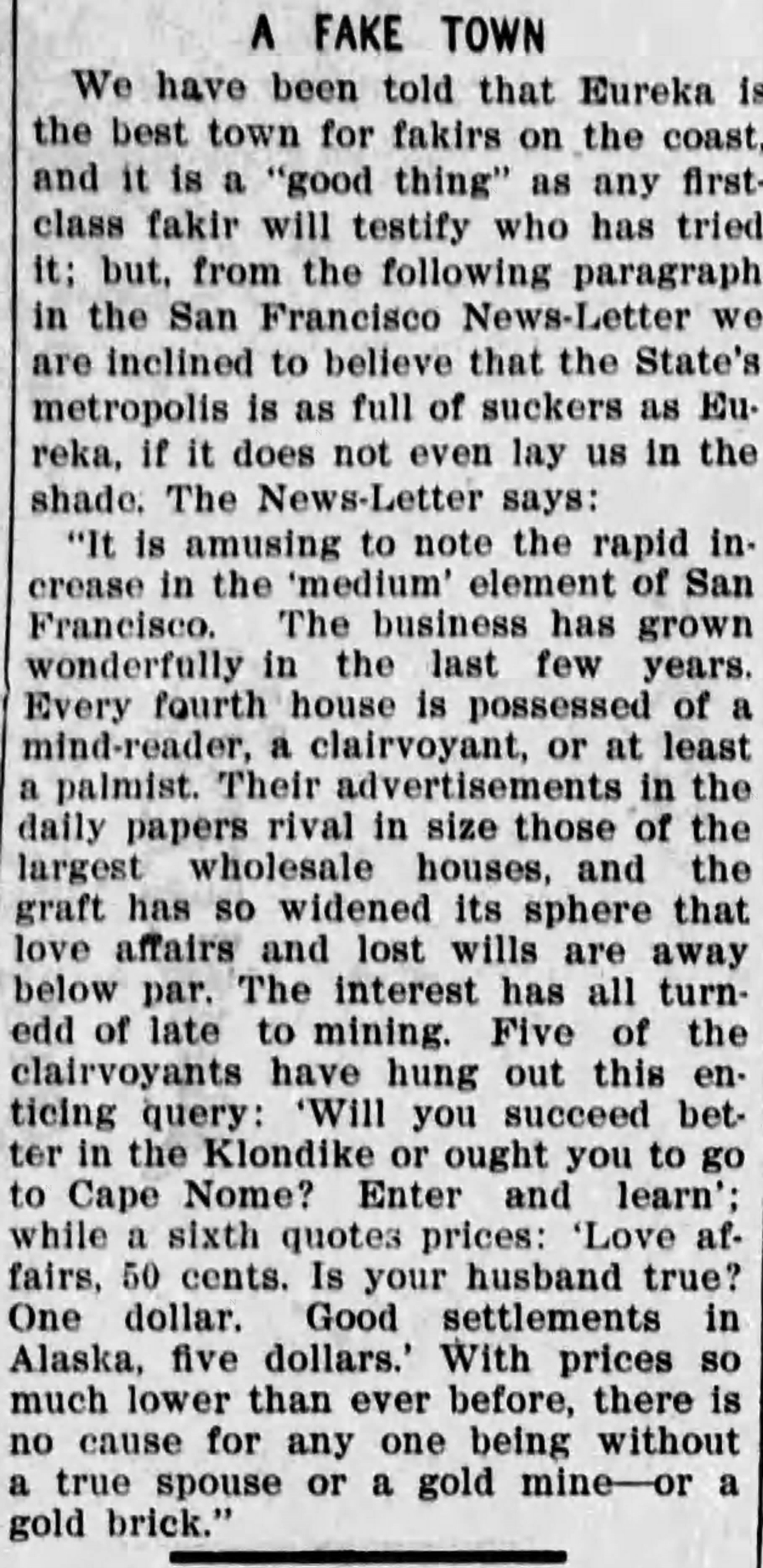
In the early 1900s, Eureka (where I live) was considered “full of suckers”, though local reporters tried to convince readers that people in San Francisco were just as gullible (see story below). Eureka’s reputation prompted many palm readers and fortune tellers to pass through here regularly despite requiring a steamer ride from San Francisco. While some may have thought themselves legit, most traveled the country, set up temporary shop and scammed the locals before moving on.
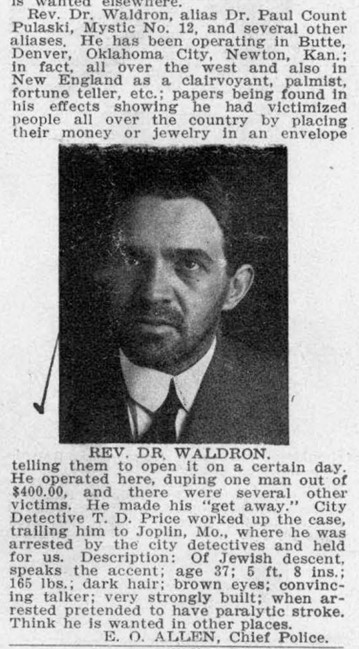
The Detective, Jan. 1911 Rev. Dr. Waldron, alias Dr. Paul Count Pulaski, Mystic No. 12, etc. (pictured on the right) made a fortune convincing patrons hoping for answers from beyond to put their valuables (money, jewelry) in envelopes to be opened later (I’d have loved to hear his script/explanation – an offering/sacrifice to the spirits, maybe?). Of course when that later day came, they found their valuables replaced with junk and Waldron long gone. When periodically arrested, he pretended to have a paralytic stroke – which likely landed him in the hospital where he could escape.
*
Mrs. FW Williams traveled the country renting rooms as temporary parlors , ran catchy ads in local papers, convinced her victims to give her jewelry worn by the person of interest and encouraged them to leave as many gold coins as possible “as then the spirits will be more apt to reveal.” [The Detective, Sept 1901]
Like Josie Stocking, featured in a previous post, and scammers today (Good Housekeeping did a story on fraud shaming- posted HERE), many criminals used their victim’s shame as protection. Folks wouldn’t want to admit they’d given money or other valuables to a charlatan, leaving the nefarious to commit their crimes again and again.

The Times Standard, March 1900 -
Head of a criminal
Read more: Head of a criminal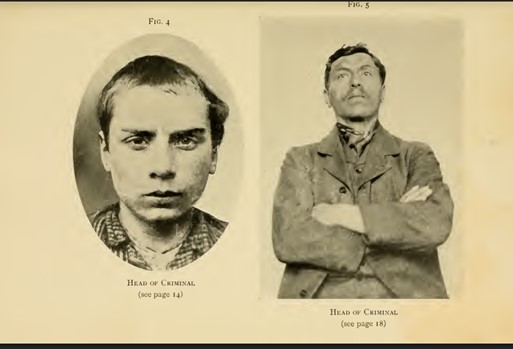
Cesare Lombroso, an Italian physician turned criminal anthropologist, published The Criminal Man in 1876 (available online HERE) asserting that thieves and prostitutes didn’t turn to crime in response to shitty life circumstances or bad choices, but because they had an inherited predisposition. Lombroso believed that criminals were evolutionarily stunted –and pretty much doomed. He also claimed that these folks could be identified by physical characteristics like asymmetrical faces, dark hair, and more—theories that sadly justified and perpetuated racial and gender stereotypes still felt today (a complicated topic that deserves its own post/ conversation another time).
Twenty years later and across the ocean, Thomas Byrnes, Superintendent of the New York Police Department, shared and expanded Lombroso’s theories , believing certain criminal types shared unique characteristics. Byrnes observed that
- The foot is a wonderful indicator of character. Honest men put their heel down squarely and walk along in confidently but not aggressively. Criminals generally put their heels down cautiously and round out their step to the toes.
- The thieving hand almost always larger in proportion than that of the honest man.
- Those that bite their nails show a vicious or criminal tendency, whether developed or not.
Huh.
Cesare Lombroso also applied his theories to women and clearly hated them though I have yet to learn why. Interestingly, his distain seems to semi-absolve women of their criminal behavior. Per Lombroso in his book The Criminal Woman, the Prostitute and the Normal Woman (I can’t find a free online version right now but will post later if I run across one)
Women have something close to what might be called an instinct for lying. Caught at something unexpectedly, they start concocting a lie (though some do this better than others). … This is so organic that they are unaware of it, and they are never able to be entirely sincere. Unconsciously, all are a little false.
That women lie habitually is confirmed by the common custom of refusing to accept, or accept much of, women’s testimony. This custom grew out of not only primitive man’s disdain for women’s weakness but also his experience with her untruthfulness. Women’s incapacity for criminal responsibility was recognized in the laws of ancient Greece and Rome and in the codes of many German peoples. Even today the Ottoman Code (article 355) provides that the deposition of a man should be worth that of two women. And in many languages the words oath and testimony as the same root as testicle.
Well isn’t that special? And all too familiar today. I’ll save more on Lombroso for another day.


 The Lower Levels